Business & Taxes
Phytosanitary Certificate in Georgia: Complete Guide
Exporting plants or food from Georgia? Learn what a phytosanitary certificate is, which goods need one, who issues it, and how to apply through the NFA.

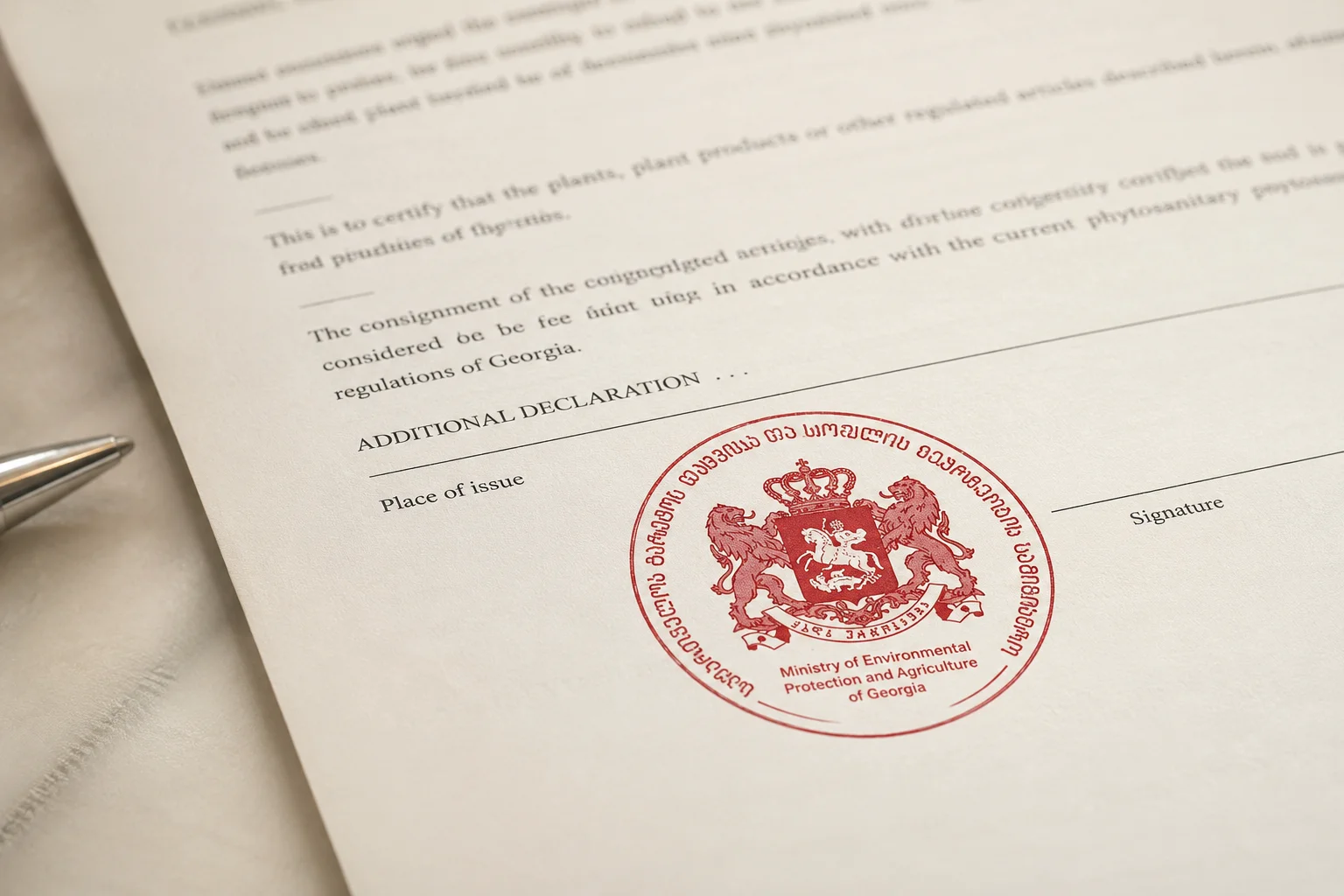
A phytosanitary certificate is an official document confirming that plants or plant products are free from quarantine pests and meet the importing country's plant-health rules. If you export produce, seeds, grain, or wood from Georgia, most destination countries will not let your goods in without one. This guide explains what a phytosanitary certificate in Georgia is, which goods need it, who issues it, and how to apply.
What is a phytosanitary certificate?
A phytosanitary certificate is an official assurance, issued by a national plant-protection authority, that a consignment of plants or plant products has been inspected and is free from quarantine pests, and that it meets the plant-health requirements of the importing country.
It travels with the goods and is presented to the destination country's authorities on arrival. The system sits under the International Plant Protection Convention (IPPC), a global framework that standardizes these certificates so they are recognized across borders, as set out by the IPPC.
Which goods need a phytosanitary certificate
The requirement covers plants and plant products that could carry pests or disease. For exports from Georgia, that typically includes:
fresh fruit and vegetables,
seeds and grain,
seedlings and other planting material,
cut flowers and live plants,
wood, timber, and wooden packaging.
If your product is plant-based or could harbor plant pests, assume a certificate is needed and confirm the destination country's specific rules. Processed foods may or may not require one depending on the importing country.
Export certificate vs import permit
This is where many exporters get confused, so it is worth separating clearly.
When you export regulated plant goods from Georgia, you obtain a phytosanitary certificate that attests the goods are pest-free and meet the buyer country's rules.
When you import such goods into Georgia, the requirement is different: you need a permit on the import of goods subject to phytosanitary and veterinary control, issued before the goods arrive. So the export side produces a certificate, and the import side requires a permit. If you bring plant goods in as well, factor this into how you import goods to Georgia.
Who issues it in Georgia
Phytosanitary certificates in Georgia are issued by the National Food Agency (NFA), which operates under the Ministry of Environmental Protection and Agriculture. Its plant-protection function handles quarantine inspection and certification.
The NFA inspects consignments and issues the certificate, drawing on laboratory testing where needed. The agency's role within Georgia's plant-health system is documented by the National Food Agency and in a system overview published through the CAREC Program. The wider ministry context is on mepa.gov.ge.
How to apply
The process is largely electronic and follows a clear sequence:
Submit an application to the NFA for a phytosanitary certificate, attaching an extract from the business register (for a company) or identification (for an individual).
The NFA carries out a documentary check of the application.
An inspector performs a phytosanitary inspection of the consignment.
Laboratory testing is done if the goods or destination require it.
The certificate is issued once the goods pass.
Because the certificate reflects the condition of the goods at inspection, it is usually arranged close to the shipment date rather than far in advance.
Cost, processing time, and validity
Fees for a phytosanitary certificate are modest and depend on whether a physical inspection or laboratory test is required, and on whether you apply during or outside working hours. Processing usually takes a few working days, so build that into your shipping schedule.
Validity is tied to the consignment and the destination country's requirements, since the certificate attests to the goods' condition at the time of inspection. Because fees and the exact validity window can change, confirm both directly with the NFA when you apply rather than relying on older figures.
Wood packaging and the IPPC standards
One requirement catches exporters out: wooden packaging. Pallets, crates, and dunnage made of solid wood often need to be treated and marked under the international standard for wood packaging (ISPM 15), regardless of what they contain.
Georgia applies the relevant IPPC standards, so if your goods ship on wooden pallets, check that the packaging is compliant. Non-compliant wood packaging can be refused or destroyed at the destination even when the goods themselves are fine. The standards are maintained by the IPPC.
Re-export phytosanitary certificate
If goods were imported into Georgia and are then sent on to another country, a re-export phytosanitary certificate may be needed instead of a standard one. It confirms the goods met phytosanitary rules on import and remain compliant for the new destination.
This matters for traders running re-export models through Georgia. Pair it with the right certificate of origin and a correct customs declaration for a clean re-export.
Certificates, inspections, and timing can be a lot to juggle alongside a shipment. Our customs brokerage service coordinates phytosanitary and customs paperwork together, so your plant and food exports leave on schedule. It is a natural complement to how you export goods from Georgia.
Key takeaways
A phytosanitary certificate confirms plant goods are pest-free and meet the importing country's rules.
It is required for exports of produce, seeds, grain, plants, and wood from Georgia.
Exporting produces a certificate; importing such goods into Georgia requires a separate permit.
The National Food Agency issues phytosanitary certificates, with lab testing where needed.
Apply electronically, allow a few working days, and confirm current fees and validity with the NFA.
Wooden packaging often needs ISPM 15 treatment and marking, separate from the goods themselves.
Frequently asked questions
What is a phytosanitary certificate in Georgia?
It is an official document, issued by the National Food Agency, confirming that exported plants or plant products are free from quarantine pests and meet the importing country's plant-health rules. It travels with the goods and is shown to the destination's authorities. It is required for most plant and food exports.
Who issues phytosanitary certificates in Georgia?
The National Food Agency, which sits under the Ministry of Environmental Protection and Agriculture, issues them. The agency inspects the consignment and draws on laboratory testing where needed. It is the single authority for phytosanitary certification.
Which goods need a phytosanitary certificate?
Plants and plant products such as fresh fruit and vegetables, seeds, grain, seedlings, cut flowers, and wood or timber typically need one for export. If your product is plant-based or could carry plant pests, assume a certificate is required. Always confirm the destination country's specific rules.
How do I get a phytosanitary certificate in Georgia?
Apply to the National Food Agency, attaching a business register extract or identification. The agency runs a documentary check, inspects the consignment, carries out lab testing if needed, and issues the certificate once the goods pass. The process is largely electronic.
How long does it take to get a phytosanitary certificate?
It usually takes a few working days, depending on whether laboratory testing is required. Because the certificate reflects the goods at inspection, it is arranged close to the shipment date. Build the lead time into your export schedule.
How much does a phytosanitary certificate cost?
Fees are modest and vary with whether a physical inspection or lab test is needed, and with working hours. Because the amounts can change, confirm the current fee directly with the National Food Agency when you apply. The cost is small relative to the value of a cleared export.
What is the difference between a phytosanitary certificate and an import permit?
A phytosanitary certificate is issued when you export plant goods from Georgia, attesting they are pest-free. An import permit is what you need to bring regulated plant or animal goods into Georgia. One is for outbound goods, the other for inbound.
Do I need a phytosanitary certificate to import plants into Georgia?
To import regulated plant goods into Georgia, you need a permit on the import of goods subject to phytosanitary and veterinary control, obtained before arrival. The exporting country also supplies its own phytosanitary certificate with the goods. Both sides of the trade are regulated.
Does wooden packaging need certification?
Often, yes. Solid-wood pallets, crates, and dunnage usually must be treated and marked under the ISPM 15 standard, regardless of the goods inside. Non-compliant wood packaging can be refused or destroyed at the destination, so check it before shipping.
What is a re-export phytosanitary certificate?
It is used when goods imported into Georgia are sent on to another country. It confirms the goods met phytosanitary rules on import and remain compliant for the new destination. This is relevant for re-export and transit business models.