Business & Taxes
Rental Contracts in Georgia: The Complete Guide (+ Free Templates in English, Russian & Georgian)
Georgia's rental market runs on the Civil Code, not a tenancy act, so the written lease is where all real rights live. Learn what must be in the contract, how the flat 5% landlord tax works, deposit rules, and why registering protects tenants if the flat is sold. Free English, Russian, and Georgian templates included.

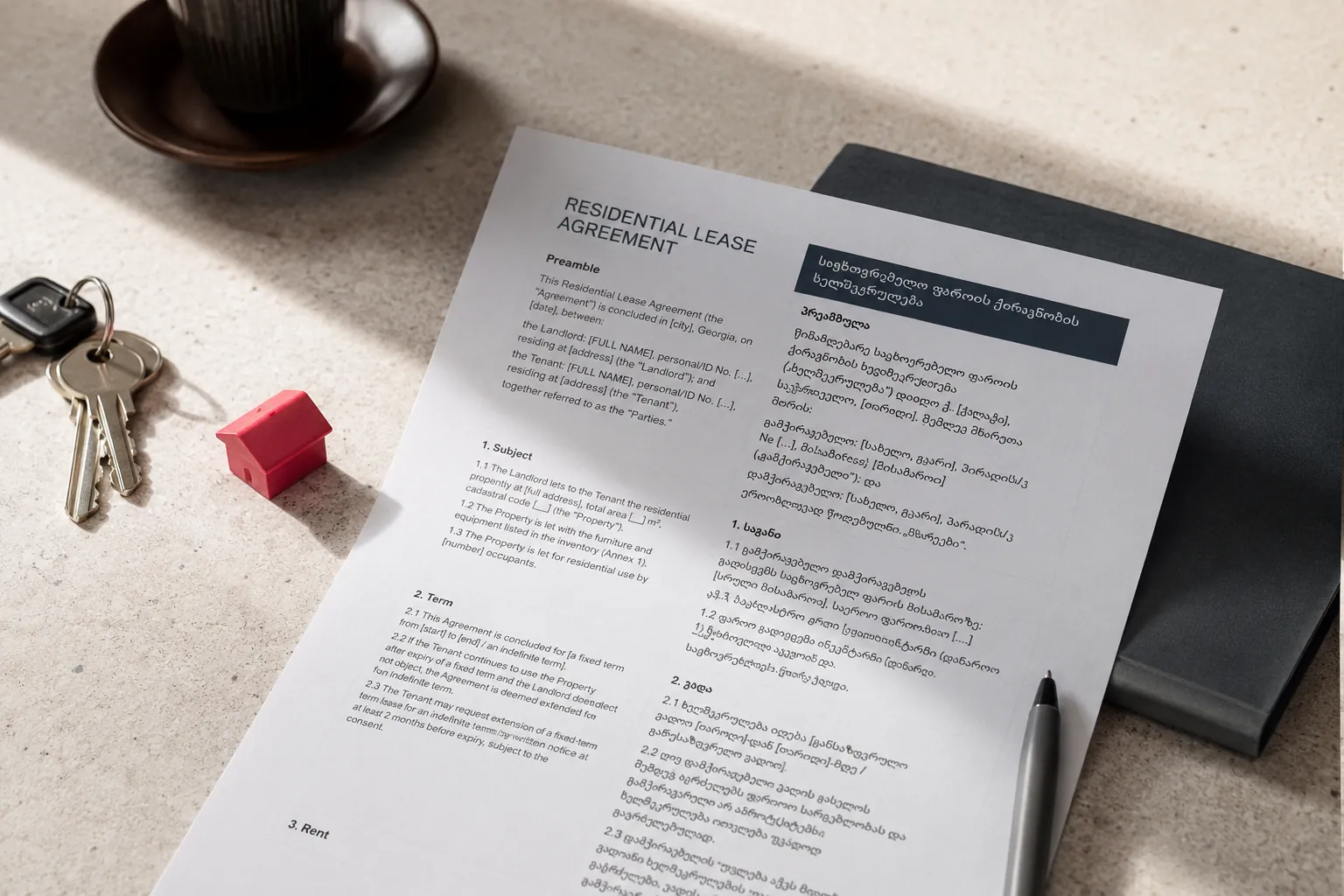
Renting in Georgia is governed by the Civil Code of Georgia, not by a dedicated tenancy act, and the framework is firmly pro-landlord. That has one clear consequence for both sides: your rights are whatever the written contract says they are. Georgian courts will enforce a clear lease, and struggle to help you without one.
This guide explains what a solid Georgian residential lease should contain, the tax angle that catches out most landlords (the flat 5% rate), and how registration protects a tenant if the flat is sold. At the bottom you can download templates in three formats: English/Georgian, Russian/Georgian, and Georgian only.
Just looking for the templates? Grab them here:
The short version
Always use a written lease. It is the tenant's only real protection in a pro-landlord system.
A fixed-term lease auto-renews indefinitely if the tenant stays on and the landlord does not object.
Register the lease at the Public Registry to keep it valid if the flat is sold mid-term.
Landlords pay a flat 5% income tax on residential rental income (individuals).
Deposits are not regulated by statute, so the contract governs the amount and return terms.
Tax Consulting for Expats in Georgia
Get clarity on IE vs LLC, residency rules, international tax planning, and more
Tax residency, VAT thresholds, double taxation, business structuring - get clear answers in English before they become expensive problems. Free 30-minute consultation.
Free Consultation
13+ Years Tax Expertise
For Professionals & Business Owners

Do you need a written rental contract in Georgia?
Legally a lease can be oral, but you should never rely on that. Because the Civil Code leans toward landlords and sets few mandatory tenant protections, the written contract is where all the real rights live: rent, term, deposit, who fixes what, and how either side can exit.
A written lease also lets you do two things that matter in Georgia: register it for protection against a future sale, and prove the terms if a deposit dispute lands in court.
What should a Georgian residential lease include?
At minimum, a usable lease covers:
The parties, with full names and personal/ID numbers.
The property: full address, area, and the cadastral code (this ties the lease to the exact registered unit).
An inventory of furniture and condition, ideally as a signed annex with photos.
Term: fixed or indefinite, with start and end dates.
Rent: amount in GEL, due date, and payment method.
Deposit: amount, what it covers, and the return timeline.
Utilities: who pays electricity, water, gas, internet, and building fees.
Maintenance: the split between the tenant's minor upkeep and the landlord's major repairs.
Termination: notice periods and grounds.
A handover act at move-in and move-out, recording condition and meter readings.
How long does a Georgian lease last, and does it auto-renew?
A lease can be fixed-term or indefinite. Two Civil Code rules surprise people:
Silent renewal. If a fixed term ends and the tenant keeps using the property while the landlord does not object, the lease is treated as extended for an indefinite term. Landlords who want a clean exit at the end date must say so, in writing, in time.
Tenant's extension request. A tenant can ask to convert a fixed-term lease into an indefinite one by giving written notice at least two months before the end date. The landlord still has to consent, but the mechanism exists and belongs in your contract.
Deposits: what the law does (and doesn't) say
Georgia has no statutory cap on deposits and no fixed rule on when they must be returned. One month's rent is the market norm (check current Tbilisi rents and cost of living). Because nothing is regulated, the contract is everything. Spell out:
the exact amount,
what it can be deducted for (damage beyond normal wear, unpaid rent or utilities),
the number of days for its return after move-out, and
whether it can be used as the last month's rent (usually state that it cannot, unless agreed).
The 5% rule: rental income tax for landlords
This is the part most landlords get wrong. An individual who rents residential property earns income that is generally taxed at a flat 5% in Georgia, with no expense deductions, provided you do not deduct costs (full breakdown in Georgia's property taxes). That is unusually low, and it applies whether you let long-term or short-term.
Key points:
The 5% rate is for individuals letting residential space. If you instead deduct expenses, the ordinary 20% regime on net income can apply.
Landlords file a personal income tax return by April 1 of the following year.
The contract should state that the landlord bears the rental income tax, so there is no confusion later.
For relocant landlords: if you sublet or re-let a flat you yourself rent, you are still earning taxable rental income. Get the head-lease's written permission to sublet first, or you risk termination for unauthorised subletting.
Who pays for utilities and repairs?
Default practice, which your contract should confirm:
Tenant pays metered utilities (electricity, water, gas), internet, and often the building's common-area cleaning.
Landlord usually covers building management fees and major/structural repairs not caused by the tenant.
Tenant handles minor day-to-day upkeep and must report faults promptly.
Record meter readings in the handover act at move-in so the final bill is clean.
Why you should register the lease
Registering the lease with the National Agency of Public Registry (NAPR) is optional, but it does one powerful thing: a registered lease survives a sale. If the landlord sells the flat during your term, a registered lease binds the new owner, while an unregistered one may not. For any lease of a year or more, registration is worth the small fee. Decide in the contract who pays it.
How to terminate a Georgian lease
Indefinite leases end on written notice from either side, with the notice period set in your contract (commonly one to three months).
Fixed-term leases run to their end date. Early exit is by agreement or on the grounds you write into the contract (for example, rent arrears past a stated number of days, or unauthorised subletting), usually after a written notice to remedy.
On exit, the tenant returns the keys and the Parties sign a handover act. Deductions for damage beyond normal wear come out of the deposit.
Language: why bilingual leases win
The Civil Code expects a contract in a language the parties understand. For a foreign landlord or a relocant tenant that means a bilingual lease, with the two languages side by side and a prevailing-language clause. For a lease governed by Georgian law, the Georgian version should usually prevail, which is why the templates below pair English or Russian with Georgian, plus a Georgian-only version.
How to complete and sign the template (step by step)
Pick the version: English/Georgian, Russian/Georgian, or Georgian-only.
Fill the property details, including the cadastral code, and attach the inventory as Annex 1.
Set rent, deposit, term and utilities, deleting the bracketed options you do not use.
Complete the handover act (Annex 2) with meter readings at move-in.
Decide on registration and who pays for it.
Sign two originals, one for each party.
If registering, file at a Public Service Hall / NAPR.
Download the templates
Georgian only residential lease (
.docx)
Frequently asked questions
Is my oral rental agreement valid in Georgia?
It can be, but in a pro-landlord system with few default protections it is a bad idea. Put it in writing.
How much can a landlord charge as a deposit?
There is no legal cap. One month is typical. Whatever you agree, write down the amount and the return terms.
Do I really pay only 5% tax on rent?
For an individual letting residential property without deducting expenses, yes, the rate is generally 5%. File your return by April 1 of the following year.
What happens if the landlord sells the flat while I'm renting?
If your lease is registered at the Public Registry, it binds the new owner. If it is not registered, your position is much weaker.
Can I sublet the apartment I'm renting?
Only with the landlord's prior written consent. Unauthorised subletting is a standard ground for termination.
Which neighbourhood should I rent in?
That comes down to budget and vibe. Our guide to where to stay in Tbilisi breaks the main districts down for newcomers.
Is it better to rent or buy in Tbilisi?
It depends on your timeline. If you are staying long term, buying as a foreigner is straightforward in Georgia and can work out cheaper than renting.
Does the lease need to be notarized?
No. A residential lease does not require notarization. Registration at NAPR is optional but recommended for longer terms.
Disclaimer. This guide and the attached templates are general information, not legal advice, and are based on the Civil Code of Georgia and current tax practice. Have the final contract, and especially the Georgian-language text, reviewed by a licensed Georgian lawyer before you rely on it.
Primary sources: Civil Code of Georgia (matsne.gov.ge); Georgian rental income tax practice (5% regime for individuals).